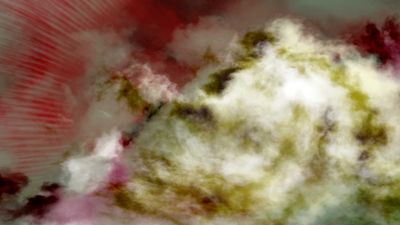
The Flaneurs - the presence of doubt
Live Immersive
Duration: 45 min.
Friday, 06 November 2026 | 21:35 > 22:202026-11-06T21:35:00.000Z | Immersive Room
An immersive exhibition in which digital pictorial images interact with the age-old sounds of the Nagauta shamisen, an instrument traditionally played by geishas in tea houses and in Kabuki theatre in ancient Japan. Joining the fray – or rather, taking a leisurely stroll – are elusive, ever-changing electronic sounds and a performative voice: spoken, diverted, embraced. The text carves out a space within the infinitely vast realm of the audio-visual imagination, where the rules are dictated by synaesthetic principles as articulated by Michel Chion.
Every culture has its own way of perceiving aimless wandering; in Italian we use terms such as bighellonare or andare a zonzo, whilst in Neapolitan, with slightly different nuances, there is ‘papariare’ (also used, exceptionally, to mean ‘swimming like a duck’ or ‘enjoying something’) or ‘ngingiuliare’ (to loiter).
Sansaku is the term used in Japan: the most elegant, ideal for describing a cultural or intellectual stroll. It is not simply a walk for exercise, but a leisurely stroll to enjoy the scenery, a historic garden or, indeed, the works of art within an exhibition. In France,
Flâneur refers to a person who wanders idly through the city streets, unhurried, experiencing and savouring emotions whilst observing the surroundings.
Author
 Loredana Antonelli is a multimedia artist and video director. Her work has been exhibited at the 56th Venice Biennale. She has collaborated with numerous museums and cultural institutions on projects involving cultural outreach, performances, videos and installations, as well as with musicians and artists on music videos and audiovisual works.
Since 2019, she has been a member of AdA, an informal collective dedicated to the performing arts. With the collective, she has received numerous awards and participated in Crossing the Sea,... Cristian Maddalena — an electroacoustic composer, improviser, and Japanese aedo (bard) — plays and studies the nagauta shamisen. He has produced several radio dramas for Rai Radio 3, and his works are performed worldwide.
He has collaborated with Lamberto Pignotti, Elio Martuscello, Barbara De Dominicis (Figures of Absence), Marco Colonna, Fabrizio Spera (Yokai), Mazen Kerbaj, Steve Baczkowsky, and ATMAN. Pasquale Passaretti is an actor and playwright. He is the co-founder of Etérnit Teatro, with productions including Tvatt, A.A.A., and Binario 2 (Special Off Award – Roma Fringe Festival). He performed in A.K.R., co-produced by Teatro Forte (Rome) and Pad of Mains (Germany), and worked as both actor and writer on Erodi by Exit.
He published Bianco Materia with La Bagarre and is the founder and artistic director of Lunarte Festival, now in its 17th edition.
Since 2019, he has been a... ADA – Informal Collective for the Performing Arts was founded in Rome in 2019 by Loredana Antonelli, visual artist and video director, Lady Maru, techno DJ and producer, and Pasquale Passaretti, actor, playwright and theatre director.
ADA creates multimedia works combining theatre, dance, live music, digital art and experimental cinema. The collective develops projects and performances for theatres, cinemas, galleries and unconventional spaces.
The collective defines itself as informal because of its ability to adapt its artistic approach and composition according to...